
 slope rider
Loading game…
Play now

- Rating
- 7.2/10
- Published
- Technology
- HTML5
- Platforms
- desktop&mobile
Slope Rider
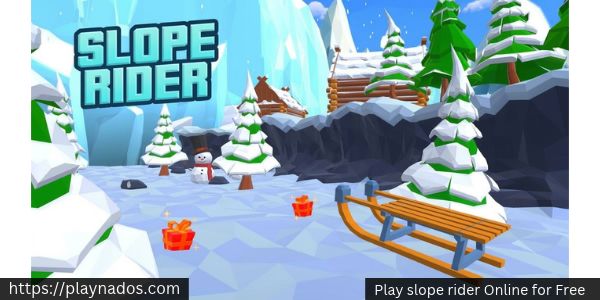
Slope Rider is a fast 3D downhill sledding game where you race automatically through snowy forests, steer around trees, rocks, snowballs and sudden gaps, jump over hazards, and collect gift boxes while trying to survive for the longest distance possible. The sled never waits for you, so every run becomes a balance between looking ahead, making small steering corrections, choosing when to jump, and deciding whether a gift is worth leaving the safest route.
The controls are simple, but the mountain is not. Obstacles can appear in awkward combinations, terrain changes quickly, and a safe opening can disappear by the time you reach it. One collision can finish the run immediately, making clean route selection more important than constantly switching direction.
How Slope Rider Gameplay Works
Your sled moves downhill automatically.
You control three basic actions:
- steer left;
- steer right;
- jump.
There is no need to hold an acceleration button.
Instead, your attention stays on the terrain ahead.
The objective is straightforward:
travel as far as possible without crashing.
Your score continues growing while the run remains alive.
That makes survival the main priority.
A gift may help your progression, but a gift placed beside a tree or dangerous gap is not automatically worth collecting.
Read the Slope Before You Move
Slope Rider becomes easier when you stop reacting directly in front of the sled.
Look farther ahead.
Try to identify:
- where the next safe lane is;
- which obstacle is moving;
- whether a gap requires a jump;
- where you will land;
- and whether another obstacle is waiting immediately afterward.
A late reaction often forces a large steering movement.
Large movements are harder to control.
Early decisions give you more room to make small corrections.
Small Steering Inputs Are Safer
One of the easiest ways to lose a good Slope Rider run is oversteering.
If you hold left or right too long, the sled can move from one dangerous side of the slope directly into another.
Instead, use short inputs.
A small tap can move you around a tree while keeping the sled near a useful central position.
After avoiding the obstacle, release the control and reassess the next section.
The goal is not to constantly move.
The goal is to move only as much as necessary.
Why Staying Near the Center Helps
When the path allows it, a central position gives you more options.
From the middle, you can move:
- left;
- right;
- or stay straight.
If you ride too close to one edge, half of your escape routes disappear.
A new tree or rock can trap you against the side before you have enough time to recover.
That does not mean the center is always safe.
It means the center is often the best neutral position when you do not yet know what is coming next.
Jump Only When You Need It
Jumping is useful, but it should not become an automatic reaction.
A jump can help you clear:
- logs;
- gaps;
- low hazards;
- and difficult sections where steering alone is not enough.
But every jump creates another problem:
the landing.
You have less control while airborne.
If you jump unnecessarily, you may land directly in front of the next obstacle.
Before jumping, look beyond the obstacle you want to clear.
Ask:
Where am I going to land?
If the landing zone is crowded, steering around the hazard may be safer.
Dynamic Obstacles Need Earlier Decisions
Static trees are simple once you see them.
Moving hazards are harder because their position changes while you approach.
For a rolling snowball or shifting obstacle, do not aim at the place that is open right now.
Estimate where the obstacle will be when your sled reaches it.
Sometimes the safest route is behind the moving hazard rather than trying to beat it in front.
Waiting a fraction longer before changing direction can create a cleaner path.
Falling Trees Can Change a Safe Route
A clear section of snow does not always stay clear.
If a tree begins falling across your route, you need to decide quickly whether to:
- steer around it;
- jump if the obstacle can be cleared;
- or abandon the route completely.
Do not fixate on the obstacle itself.
Look for the largest remaining safe area.
The correct move is often simpler than trying to squeeze through the smallest opening.
Rolling Snowballs Require Space
Snowballs create a different type of threat because they move across the slope.
The mistake is trying to dodge them at the last second.
Give yourself distance.
When you spot one early:
- identify its direction;
- predict where it crosses your path;
- choose the opposite safe lane;
- keep enough room to correct after it passes.
A clean early adjustment is much safer than a panic turn directly beside it.
Gaps and Cliffs Punish Wide Turns
Not every danger is something you can collide with.
The terrain itself can end your run.
When the snowy path narrows near a cliff or gap, avoid holding a steering input longer than necessary.
Small taps become especially important here.
A large correction that would be harmless in an open forest can send the sled off the mountain on a narrow section.
Collect Gifts Without Throwing Away the Run
Gift boxes are one of Slope Rider’s main progression rewards.
You can collect them during a run and use them toward additional sleds.
But gifts create a useful risk-versus-reward decision.
Imagine two paths:
Path A: safe and empty.
Path B: contains a gift but also forces you between several obstacles.
The gift is not free.
The real cost is the risk you accept to collect it.
Early in a run, taking a safe gift makes sense.
During a high-score attempt, surviving may be far more valuable.
Do Not Turn Late for a Gift
A common mistake is seeing a present just as you are passing it and making a sudden turn.
That usually creates more danger than the gift is worth.
If you cannot line up the pickup comfortably before reaching it, let it go.
There will be more gifts.
Your current run disappears after one crash.
Unlock Different Sleds
Collected gifts contribute to the sled unlock system.
This gives repeated runs a second purpose beyond chasing a distance record.
Even if you do not beat your best score, collecting gifts can still move you closer to another sled.
That creates two progression goals:
Survival progression: travel farther.
Collection progression: unlock more sled designs.
You do not need to chase both aggressively on every run.
Some attempts can focus on gifts.
Others can focus purely on distance.
A Better Strategy for High Scores
When your main objective is a new record, change your priorities.
First Priority: Survival
Never take a risky gift if it significantly increases your chance of crashing.
Second Priority: Position
Stay where you have multiple escape routes.
Third Priority: Early Reading
Look at the upcoming terrain, not directly at the sled.
Fourth Priority: Controlled Inputs
Avoid large swerves unless the obstacle genuinely requires one.
Fifth Priority: Safe Jumps
Check the landing area before leaving the ground.
This approach may look slower or less dramatic, but it produces much more consistent runs.
Learn the Difference Between Steering and Jumping Problems
Some obstacles should be avoided.
Others should be jumped.
Trying to solve every hazard with the same action causes unnecessary crashes.
If there is plenty of open snow beside a tree:
steer around it.
If a low obstacle blocks the entire safe route:
jump may be the better solution.
If there is a dangerous landing after the obstacle:
look for another path before committing to the jump.
The best Slope Rider players choose the correct tool for each situation instead of reacting with the same move every time.
Do Not Follow the Gift Trail Blindly
Several gifts appearing in a useful line can tempt you into following them automatically.
Keep checking the terrain.
A collectible trail is not necessarily a guaranteed safe route.
If the next gift pulls you toward a crowded section, leave the line and prioritize survival.
Collectibles should influence your route.
They should not control it.
Use Open Terrain to Reset Your Position
After a difficult dodge, your sled may end up near the edge of the course.
If the next section is open, use that opportunity to gradually return to a safer neutral position.
Do not wait until the next obstacle appears.
Entering a difficult section already badly positioned creates an unnecessary disadvantage.
Open terrain is your chance to prepare.
The Terrain Changes From Run to Run
Slope Rider is built around an endless-style descent rather than one short fixed course.
That means you should learn situations, not memorize one exact sequence.
Practice recognizing:
- trees narrowing the route;
- moving obstacles crossing the slope;
- gaps that need a jump;
- crowded gift locations;
- and safe landing zones.
When you understand the situation, you can react even when the exact layout changes.
Speed Makes Simple Obstacles Harder
A single tree is not complicated.
The problem is how quickly you need to respond to it.
As the pace increases, your reaction window becomes smaller.
This is why looking ahead becomes more valuable during longer attempts.
At higher speed, waiting until an obstacle reaches the sled gives you almost no time to recover.
Good positioning begins several seconds before the danger arrives.
Slope Rider Controls
Desktop
- Left Arrow / A: Steer left
- Right Arrow / D: Steer right
- Up Arrow / W: Jump
The exact alternate keys can depend on the hosted build, so follow the on-screen instructions if your version uses a slightly different layout.
The core control idea remains the same:
steer, jump, and survive.
Beginner Strategy
If you are new to the Slope Rider game, forget gifts during the first few attempts.
Focus only on staying alive.
Practice:
- making small left and right movements;
- returning toward the middle after a dodge;
- recognizing obstacles earlier;
- jumping without overcorrecting in the air;
- and looking at the landing zone.
Once those movements become comfortable, start adding gifts into your route.
Trying to learn steering, jumps, terrain and gift collection simultaneously makes the game feel harder than it actually is.
Intermediate Strategy
Once basic survival feels comfortable, begin planning two obstacles ahead.
Instead of thinking:
“I need to avoid this tree.”
Think:
“I will pass the tree on the right, then stay right because the next obstacle blocks the center.”
That small shift from reaction to planning makes a major difference.
The faster the run becomes, the more valuable this habit is.
Long-Run Strategy
During a strong attempt, avoid unnecessary risks.
You have more to lose.
A gift worth collecting at 100 meters may not be worth chasing when you are close to beating your record.
As your distance grows:
- prioritize wider routes;
- reduce aggressive gift collection;
- avoid unnecessary jumps;
- and keep your sled positioned where you have multiple exits.
The goal changes from gaining everything possible to protecting the run.
Common Slope Rider Mistakes
Watching the Sled Instead of the Terrain
You see obstacles too late.
Better: focus farther down the slope.
Holding Left or Right Too Long
You overcorrect into another hazard.
Better: use shorter steering taps.
Jumping Without Checking the Landing
You clear one obstacle and crash immediately afterward.
Better: inspect the landing zone first.
Chasing Every Gift
You leave a safe route for a dangerous collectible.
Better: skip gifts that require sharp or late movement.
Staying Near the Edge
You lose one entire direction of escape.
Better: return toward a neutral position whenever the terrain gives you space.
Panicking Around Moving Obstacles
You make several rapid corrections.
Better: identify the hazard’s direction and choose one clean escape line.
Tips for Surviving Longer
Look Beyond the Closest Obstacle
One successful dodge means nothing if it places you directly in front of the next hazard.
Make One Decision at a Time
Choose a route, execute it, then reassess.
Let Unsafe Gifts Go
Progress from a gift is never worth ending an excellent run unnecessarily.
Jump Late Enough to Understand the Landing
Do not launch simply because an obstacle exists far ahead.
Avoid Unnecessary Side-to-Side Movement
Every extra correction introduces another chance to make a mistake.
Stay Calm When the Course Gets Crowded
Several small controlled movements are usually safer than one huge swerve.
Slope Rider vs Snow Rider 3D
Slope Rider and Snow Rider 3D share the same broad winter sledding idea, but they should not automatically be treated as the same game.
Both involve downhill survival, obstacles and collectible gifts, which is why they can look very similar at first.
However, Slope Rider is presented as its own game with its own builds, terrain behavior and progression.
If you already know Snow Rider 3D, the basic skills transfer easily:
- look ahead;
- steer smoothly;
- avoid unnecessary risk;
- and time jumps carefully.
But Slope Rider should still be treated as a separate title rather than simply another name for Snow Rider 3D.
Is Slope Rider the Same as Slope Rider 3D?
No.
Slope Rider 3D is also used as the name of a newer or separate game/build on current gaming sites.
For that reason, this page targets Slope Rider as its own title rather than using Slope Rider 3D as an interchangeable name.
This avoids confusing different games that happen to share very similar winter-sledding keywords.
Slope Rider Unblocked
Players searching for Slope Rider unblocked are generally looking for a browser-accessible version of Slope Rider.
“Unblocked” is not a different sled, level or official mode.
The underlying gameplay remains the same:
ride downhill, avoid obstacles, collect gifts and survive for as long as possible.
Whether a particular school or workplace network allows access depends on that network’s own restrictions.
Slope Rider Online
Slope Rider’s simple controls make it well suited to browser play.
You can understand the objective within one attempt and immediately begin improving:
- steer more smoothly;
- read hazards earlier;
- time jumps better;
- collect safer gifts;
- and push for a longer distance.
That quick restart loop makes short attempts useful even when they end after only a few obstacles.
Slope Rider FAQ
What is Slope Rider?
Slope Rider is a downhill endless sledding game where you steer through snowy terrain, avoid winter hazards, jump when necessary, collect gifts, and try to travel as far as possible before crashing.
Is Slope Rider the same as Snow Rider 3D?
No. The games share a very similar winter sledding concept, but current listings treat Slope Rider and Snow Rider 3D as separate titles.
Is Slope Rider the same as Slope Rider 3D?
No. Current sites also list Slope Rider 3D separately, so it is safer and more accurate to treat Slope Rider as its own game.
How do you play Slope Rider?
The sled moves forward automatically. Steer left or right to avoid hazards and use the jump control when an obstacle or gap cannot be safely avoided.
What is the goal in Slope Rider?
Travel as far as possible without hitting an obstacle or falling off the snowy route.
What happens when you crash?
The current run ends and you need to restart.
Can you stop the sled?
No. The challenge is based around continuing downhill movement, so you need to make decisions while the sled keeps moving.
What obstacles are in Slope Rider?
You can encounter winter hazards such as trees, rocks or icy boulders, logs, snowballs, gaps and other terrain obstacles.
Can obstacles move?
Some Slope Rider versions use dynamic hazards such as rolling snowballs, falling trees and shifting obstacles, so you need to predict where they will be when you reach them.
What do gift boxes do?
Gift boxes are collectibles used toward progression and unlocking additional sled designs.
Should I collect every gift?
No. Skip a gift if reaching it forces you through a dangerous route. Staying alive is more important during a high-score attempt.
How do you jump in Slope Rider?
The common desktop control is the Up Arrow or W, although the exact alternative key can vary by hosted version.
How do you steer?
Use the Left and Right Arrow keys, with A and D supported in many versions.
What is the best strategy for Slope Rider?
Look ahead, stay near a useful central position when possible, use small steering inputs, jump only when necessary, and avoid risky gifts during strong runs.
Why do I keep crashing after a jump?
You may be watching only the obstacle you are jumping over. Check the landing area and the hazard immediately after it before leaving the ground.
Why do I keep oversteering?
Holding a direction for too long creates large lateral movement. Use shorter taps and release once the sled has moved far enough.
How do I get a higher score?
Survive longer. Focus on controlled steering and early route decisions rather than constantly chasing collectibles.
Is Slope Rider a racing game?
It uses speed and downhill movement, but its main objective is survival and distance rather than racing another player to a finish line.
Is Slope Rider multiplayer?
The standard endless Slope Rider experience is focused on a single player’s survival run rather than direct multiplayer racing.
Is Slope Rider free to play online?
Browser-hosted versions are available to play online without purchasing a traditional downloadable game first.
What does Slope Rider Unblocked mean?
It is a common search term for browser access to the game, not an official separate game mode.
Is Slope Rider difficult?
The controls are easy to learn, but longer runs become difficult because you have less time to read hazards and choose a safe route.
What should a beginner practice first?
Ignore difficult gift pickups and practice short steering taps, safe jumping, looking ahead and returning toward a neutral position after every dodge.
Similar Games To Slope Rider
Slope 3 — For a faster reflex challenge, Slope 3 puts you on a narrow neon track where the ball speeds up and every late steering move can end the run.
Snow Rider 3D — If you want another snowy downhill challenge, Snow Rider 3D focuses on sled control, jumps, gifts, and surviving increasingly crowded winter obstacles.

















Comments